
Introduction
When you imagine the most isolated place on Earth, you might picture a frozen polar region or some anonymous desert. Yet, the most remote location is actually deep in the ocean: Point Nemo. Globally, it stands as the oceanic pole of inaccessibility — the point in the open waters farthest from any land. In India and elsewhere, it serves as a striking symbol of human remoteness, the power of nature and the reach of our technology. In this article for Trend Times 24, we explore what Point Nemo is, why it matters, and what its implications are — especially as the world becomes more connected yet still finds true isolation.
What is Point Nemo?
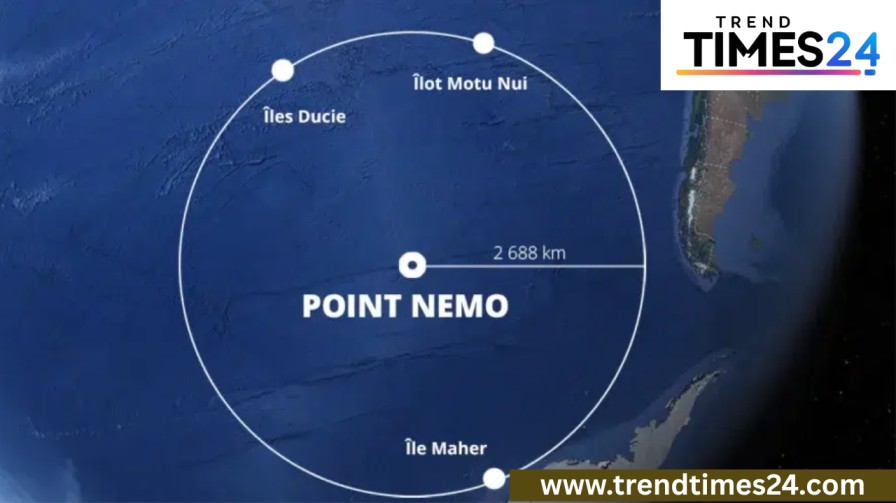
The term “pole of inaccessibility” refers to the point that is furthest from a given boundary — in this case, the boundary is landmasses, and the point is in the ocean. Point Nemo lies in the South Pacific Ocean and is about 2,688 km from the nearest land masses.
Its coordinates are approximately 48°52.6′ S, 123°23.6′ W. The site was identified in 1992 by Croatian-Canadian geodetic engineer Hrvoje Lukatela using computer-based mapping of the planet’s shape. The name “Nemo” means “no one” in Latin — aptly given — and references the fictional submarine-captain Captain Nemo from Jules Verne’s Twenty Thousand Leagues Under the Seas.
Why is it so remote?
There are several reasons why Point Nemo holds the title of “most remote”:
-
The three nearest land points — Ducie Island (Pitcairn Islands) to the north, Motu Nui (near Easter Island) to the northeast, and Maher Island (off Antarctica) to the south — are all at roughly equal distance.
-
It lies within the South Pacific Gyre, a large system of rotating ocean currents that inhibits inflow of nutrient-rich water, making the region a biological “desert”.
-
Due to the sheer distance from land, shipping and human stations are rare in its vicinity. In fact, at certain times, the nearest humans to Point Nemo may be those aboard the International Space Station orbiting ~400 km above Earth.
Unique Characteristics & Facts
Spacecraft Graveyard:
Because of its remoteness and distance from inhabited land, Point Nemo has become a preferred “soft landing” zone for de-orbiting spacecraft and satellites — a sort of deep-ocean “cemetery” for space debris
Biological desert:
Marine life is notably sparse because the South Pacific Gyre prevents nutrients from arriving — the ecosystem is among the least productive in the oceans
Cultural & scientific interest:
-
The location challenges our concepts of “remoteness” in the 21st century.
-
It features in modern ocean races such as the Vendée Globe, where yachts pass near the point
-
In myth and fiction, it has been referenced (for example, by H.P. Lovecraft and in popular culture) as an eerie spot in the deep ocean

Global Context & Significance
Globally, Point Nemo serves as a reminder that despite globalisation and connectivity, there remain places on Earth where human presence is virtually non-existent. It challenges explorers, oceanographers, geographers, and environmental scientists to think beyond inhabited zones.
Even more, using such remote zones for spacecraft disposal reflects human technological reach and its unintended environmental footprint.
India’s Relevance & Insights
For India — a country with an extensive coastline and deepening interest in oceanography, maritime security and space-technology disposal — Point Nemo offers several insights:
-
Maritime strategy & research: As Indian scientists engage more with oceanographic expeditions (e.g., in the Indian Ocean), understanding remote zones like Point Nemo sharpens models of ocean circulation, nutrient flows and debris accumulation.
-
Space-tech disposal policies: India’s space agency (ISRO) and its partners can reflect on how remote oceanic zones are managed for end-of-life spacecraft, considering environmental ethics and international cooperation.
-
Environmental leadership: The notion that even the “middle of nowhere” isn’t immune to plastic pollution (studies show debris reaches Point Nemo) speaks to India’s impetus in ocean-plastic mitigation and the UN’s Clean Sea initiatives.
-
Symbolic education & public engagement: Point Nemo can be used in Indian science-education to stir curiosity among youth about geography, ocean science, remote sensing and global systems beyond land-centred views.

Final Insight
In short: Point Nemo is far more than a curiosity. It is both a geographic extremity and a metaphor for remoteness, technological reach and environmental consequence. For Trend Times 24, we recognise it as a vital story of how human systems — space, ocean, environment — converge in places we can barely reach yet influence.
And for India, this “no-man’s ocean spot” invites us to widen our lens: to beyond land, beyond the familiar, into the oceans’ depths and the fringe of human presence. The next time you hear “the middle of nowhere”, remember: the middle of nowhere might just be Point Nemo — 2,700 km from the nearest land, yet intimately connected to our planetary story.