
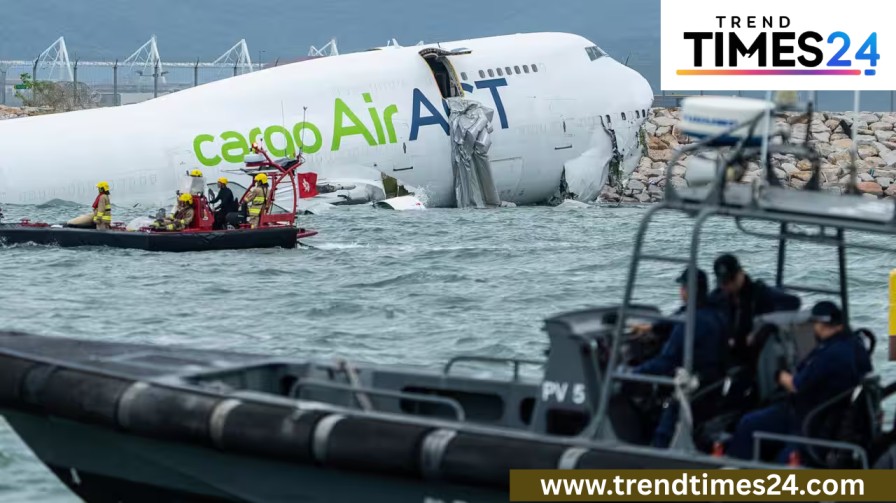
Two days after the fatal cargo-plane accident at Hong Kong International Airport, aviation investigators are piecing together the moments that led to the crash of Emirates SkyCargo Flight EK9788, operated by Turkish carrier Air ACT Airlines.
The Boeing 747-400F, arriving from Dubai in the early hours of Monday, skidded off runway 07R, struck an airport security vehicle, and plunged into the sea—killing two airport staff members and injuring none of the four crew on board.
The incident, now dubbed Hong Kong’s worst airport disaster in 25 years, has triggered a multi-agency investigation involving local and international experts.
The Early Theories
Investigators from the Air Accident Investigation Authority (AAIA) have begun analyzing flight-data and cockpit-voice recorders recovered from the semi-submerged aircraft. While the official cause may take months to confirm, early data and eyewitness accounts point to several possible factors:
- Crosswind and runway conditions:
- Heavy rain and low-visibility winds were reported around 3:50 a.m., the time of landing.
- Preliminary radar data indicates the plane veered left moments after touchdown, suggesting either uneven traction or a crosswind-induced yaw.
- Mechanical or hydraulic failure:
- Aviation experts say the Boeing 747’s spoilers or left-side brakes could have malfunctioned, causing the aircraft to lose directional control.
- “Runway excursions like this usually involve a combination of wet surface and partial brake failure,” explained veteran pilot Capt. Michael Tan, a former cargo captain with Cathay Pacific.
- Human-factor variables:
- Investigators will analyze crew rest records, radio communication, and cockpit inputs to determine whether pilot fatigue or disorientation contributed to the crash.
- So far, no distress call or “Mayday” transmission was made, suggesting the crew believed the landing was routine—until seconds before impact.

What We Know About the Victims
The two men killed were airport security officers conducting routine patrols along the north-runway perimeter road. Authorities emphasized that their vehicle was not on the runway but was struck when the aircraft veered sharply left.
Both were recovered from the water shortly after the accident; one died at the scene, the other later in hospital. The tragedy has prompted a review of ground-vehicle positioning protocols, even though investigators confirmed the patrol route followed standard procedures.
Air-Traffic Control and Communication Logs
Audio from LiveATC.net reviewed by Reuters shows the flight had been cleared to land on runway 07R, with no reported technical concerns. The tower controller maintained regular contact, and all communications appeared normal until the moment of touchdown.
Chief accident investigator Man Ka-chai confirmed that no emergency call was received:
“The aircraft was directed to land on the north runway. We received no request for assistance. Everything appeared normal until the sudden deviation.”
The Aircraft: A Boeing 747-400 Freighter
The 26-year-old Boeing 747 involved in the crash had been previously operated by several major carriers before being converted into a freighter by Air ACT Airlines, a Turkish cargo specialist that partners with Emirates SkyCargo.
Maintenance records show it underwent routine inspection in August 2025, with no outstanding technical issues. Still, investigators are examining whether component fatigue—such as tire burst, rudder malfunction, or brake-system failure—could have played a role.
Runway and Weather Analysis
Hong Kong International Airport, built on reclaimed land, is notorious for variable crosswinds and humidity, especially during early-morning hours. Meteorological data indicates light rain showers and wind shear alerts at the time of the landing.
The Airport Authority Hong Kong (AAHK) has temporarily closed runway 07R pending friction tests, debris removal, and environmental safety checks due to partial fuel leakage. The rest of the airport continues to operate normally.
Expert Commentary
Aviation safety expert Dr. Helen Lau, from the University of Hong Kong, noted that while large cargo jets are designed to handle challenging conditions, even minor mechanical or weather anomalies can turn critical at landing speed.
“Runway excursions remain one of aviation’s most persistent risks. The fact that this happened at one of the world’s most advanced airports shows that even top-tier systems depend on human-machine synergy.”
What Happens Next
- Preliminary report: Expected within 30 days, providing early findings on aircraft data, weather, and communications.
- Final report: Typically released within 12 months, detailing root causes and safety recommendations.
- Runway reopening: The north runway will reopen once structural and environmental checks are complete.
Both Emirates SkyCargo and Air ACT Airlines have pledged full cooperation, and Boeing has dispatched technical advisors to assist investigators.
A Somber Reminder
The tragedy underscores the complex interplay between human decision-making, machine reliability, and environmental unpredictability in aviation. For the families of the two lost workers, and for Hong Kong’s aviation community, the incident is a sobering reminder that even the most modern systems demand constant vigilance.
As the investigation unfolds, the focus will remain on one central question:
What exactly went wrong during those final seconds of flight EK9788’s landing?