
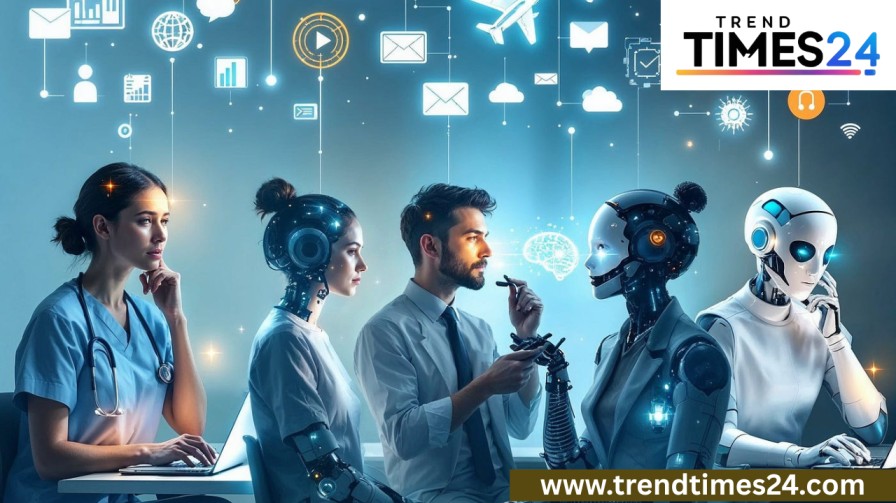
The year 2025 marks a turning point in the global workforce, as AI employees begin to replace human roles across industries. From digital assistants managing customer queries to fully autonomous bots handling financial analytics, artificial intelligence is no longer a support tool — it’s becoming the workforce itself.
As per recent reports, Fortune 500 companies in the U.S., Europe, and Asia are integrating AI-driven staff to handle repetitive, data-heavy, and even creative roles. This transition is reshaping job structures and redefining the concept of employment itself.
AI Employees: The New Corporate Revolution
AI employees — often called “digital workers” or “autonomous agents” — are software entities powered by advanced machine learning, natural language processing, and robotic automation. These bots can perform tasks like:
-
Data entry and report generation
-
Customer service and technical support
-
Market analysis and decision-making
-
Scheduling and logistics management
Unlike traditional software, AI employees can learn, adapt, and interact in real time. For example, companies like IBM and Google now employ AI-driven HR assistants capable of evaluating resumes and conducting initial job interviews — saving time and operational costs.
Global Trends: From Efficiency to Full Automation
In the United States and Europe, sectors such as finance, healthcare, and logistics are leading the AI revolution. A McKinsey report suggests that by 2025, nearly 40% of routine tasks in corporations will be automated.
China, too, has surged ahead with AI-powered manufacturing plants, where robots and software agents collaborate with minimal human oversight. Japanese firms are experimenting with AI-driven hotel staff, where virtual concierges greet guests and handle reservations without human involvement.
Meanwhile, companies are reaping benefits — faster output, lower costs, and error-free precision — driving further adoption of AI employees.
India’s AI Workforce Boom
In India, the AI employee movement is accelerating at an unprecedented pace. Tech giants and startups are using AI systems to streamline customer interactions, banking operations, and even creative processes.
According to NASSCOM, India’s AI sector is expected to contribute over $20 billion to GDP by 2026, with AI bots replacing nearly 10% of routine white-collar roles in IT, BPO, and fintech.
However, the rise of AI employees also presents challenges — especially for India’s massive human workforce. Analysts warn that without upskilling, millions could face technological unemployment. Yet, the silver lining is that AI also creates new roles in data science, AI ethics, bot supervision, and system training.
Why Companies Are Choosing AI Over Humans
The trend is driven by key business motivations:
-
Cost Efficiency: AI employees operate 24/7 without salaries, breaks, or leaves.
-
Consistency: Bots maintain uniform performance levels without fatigue.
-
Scalability: Businesses can deploy AI systems globally within hours.
-
Data Mastery: AI can process massive datasets in seconds, enabling better decision-making.
Interestingly, some firms report that AI employees outperform human workers in accuracy, productivity, and adaptability — especially in administrative and analytical roles.
The Human Side of the AI Workforce
Despite automation’s benefits, experts argue that human creativity and emotional intelligence remain irreplaceable. AI can replicate logic, but not empathy.
Companies like Microsoft and Infosys are adopting hybrid workforce models, where AI handles mechanical tasks while humans focus on strategy and innovation. This collaborative model is being seen as the “Future of Work 2.0”, blending artificial intelligence with human intuition.
Final Insight: Adapt or Be Automated
The rise of AI employees in 2025 signals both opportunity and disruption. While bots are taking over many tasks, they’re also creating a new digital ecosystem that demands human oversight, creativity, and ethics.
For businesses, embracing AI means greater efficiency and competitiveness. For workers, it means continuous learning and adaptation.
As Trend Times 24 often highlights — the future of work isn’t about humans versus AI, but humans working with AI. Those who evolve with the trend will lead the workforce of tomorrow.