
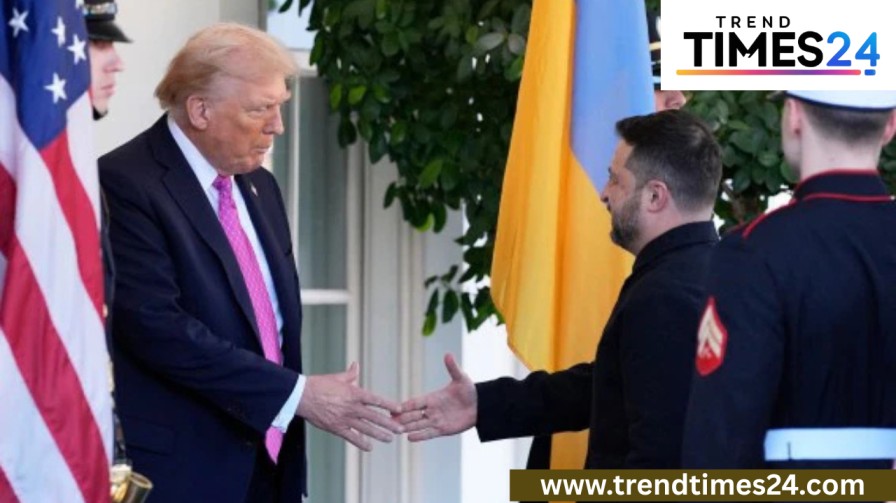
President Donald Trump met Ukrainian President Volodymyr Zelenskyy at the White House, a high-profile diplomatic meeting that could reshape U.S. foreign policy toward Eastern Europe. The two leaders discussed the ongoing Ukraine war, potential pathways to peace, and the future of U.S.–Ukraine defense cooperation. Trump emphasized his desire to end the war “without the need for Tomahawk missiles,” signaling his preference for a diplomatic solution over direct military escalation.
This meeting marks Trump’s first major bilateral engagement with Zelenskyy since returning to the White House, highlighting the renewed focus on the Russia–Ukraine conflict and the United States’ role in global peace efforts.
A Call for Peace in Ukraine
During the joint press conference, Donald Trump reiterated his hope to see the Ukraine war end peacefully, underscoring his belief that diplomacy, not aggression, should lead the way. “We want peace through strength,” Trump said, adding that the United States remains committed to supporting Ukraine’s sovereignty and security.
Strengthening U.S.–Ukraine Defense Cooperation
Beyond peace talks, both leaders hinted at expanded defense cooperation between the United States and Ukraine. Trump suggested that future military aid would focus on strengthening Ukraine’s defensive capabilities rather than fueling offensive operations. Zelenskyy welcomed the idea, noting that “U.S. support remains vital to Ukraine’s independence and territorial integrity.”
Analysts view this as a potential shift in U.S.–Ukraine relations, with an emphasis on strategic partnership, joint defense initiatives, and enhanced cybersecurity cooperation. This aligns with Trump’s broader foreign policy priorities—reducing prolonged conflicts while maintaining America’s global influence.
Global Reactions to the Trump–Zelenskyy Meeting
The Trump–Zelenskyy meeting has sparked reactions worldwide. European leaders cautiously welcomed Trump’s remarks on peace but expressed concern about how his administration might balance diplomacy with deterrence. Russian officials, meanwhile, have closely monitored the discussions, viewing the potential for renewed U.S.–Ukraine defense cooperation as a challenge to Moscow’s interests.
International media outlets, including CNN, BBC, and Reuters, have all covered the story extensively, focusing on Trump’s statement about avoiding “Tomahawk missiles.” The comment underscored his intention to de-escalate tensions while maintaining strong U.S. deterrence capabilities.
Trump’s Vision for U.S. Foreign Policy
This meeting fits into Donald Trump’s broader foreign policy doctrine, which emphasizes negotiation over confrontation. During his presidency, Trump often advocated for ending “endless wars” and prioritizing American interests abroad. His current approach to the Ukraine crisis reflects a continuation of that strategy, combining strong rhetoric with calls for peace.
According to political analysts, Trump aims to position himself as a global peacemaker, capable of mediating between conflicting nations while keeping U.S. defense interests intact.
The Road Ahead for U.S.–Ukraine Relations
As both nations navigate the complex realities of the Russia–Ukraine war, the Trump–Zelenskyy meeting could serve as a turning point. The two leaders agreed to establish a joint task force on peace and reconstruction, designed to explore diplomatic, economic, and humanitarian pathways toward ending the conflict.
For Ukraine, continued U.S. engagement provides critical support in the face of ongoing Russian aggression. For the United States, it reaffirms Washington’s influence in global diplomacy and its commitment to a stable, secure Europe.
Conclusion: A Step Toward Diplomacy and Stability
President Donald Trump’s meeting with Volodymyr Zelenskyy at the White House represents a renewed push for diplomacy amid the ongoing Ukraine war. By calling for an end to the conflict “without Tomahawk missiles” and promoting U.S.–Ukraine defense cooperation, Trump has sent a clear message: peace and strength can coexist.
As the world watches closely, the success of this diplomatic effort could shape the next chapter of U.S. foreign policy, redefine American involvement in Eastern Europe, and potentially bring the world closer to ending one of its most devastating wars.